
The UAE’s e-invoicing mandate introduces a structured, digital way for businesses to issue, exchange, and report invoices to the Federal Tax Authority (FTA). While the framework may feel complex at first, especially for organisations with multiple entities or legacy ERP systems, the underlying principles are clear once broken down step by step.
Understanding the timelines, onboarding requirements, and document flow is essential for staying compliant and avoiding last-minute implementation pressure. This guide explains how e-invoicing in the UAE works, who it applies to, and how invoices move between suppliers, buyers, accredited service providers, and the FTA under the mandated model.
UAE E-Invoicing Phases and Key Dates
The UAE e-invoicing rollout is being implemented in phases, with requirements determined primarily by company size and entity type. This phased approach allows businesses time to prepare while ensuring larger organisations lead adoption.
Phase One: Large Businesses
Phase One applies to companies with annual revenue of AED 50 million or more. These organisations are required to begin preparing for e-invoicing well ahead of the mandatory go-live date.
Key milestones include:
- Accredited Service Provider (ASP) appointment deadline: 31 July 2026
- Mandatory go-live date: 1 January 2027
Appointing an ASP means selecting an approved e-invoicing solution from the list published on the EmaraTax portal and completing the registration process with that provider. This step is mandatory and forms the foundation for PEPPOL onboarding, invoice validation, and FTA reporting.
Phase Two: Smaller Businesses
Phase Two applies to companies with revenue below AED 50 million. While these businesses are not required to go live at the same time as Phase One entities, they are still expected to prepare for future adoption.
At this stage:
- Go-live timelines will be announced separately by the FTA
- Businesses should monitor guidance closely and begin assessing system readiness
Phase Three: Government Entities
Phase Three applies exclusively to government organisations. These entities will follow a separate rollout path defined by the FTA.
Pilot and Voluntary Adoption
In addition to the phased rollout, two early-adoption scenarios exist:
- Companies invited by the FTA to participate in pilot testing must go live earlier, regardless of their assigned phase
- Voluntary early adoption of e-invoicing begins on 1 July 2026, allowing businesses to implement ahead of mandatory deadlines
Core E-Invoicing Rules to Know
Before getting into the technical document flow, there are several foundational rules that apply to all mandated businesses using e-invoicing software.
These rules align closely with existing UAE VAT requirements but are enforced through digital channels:
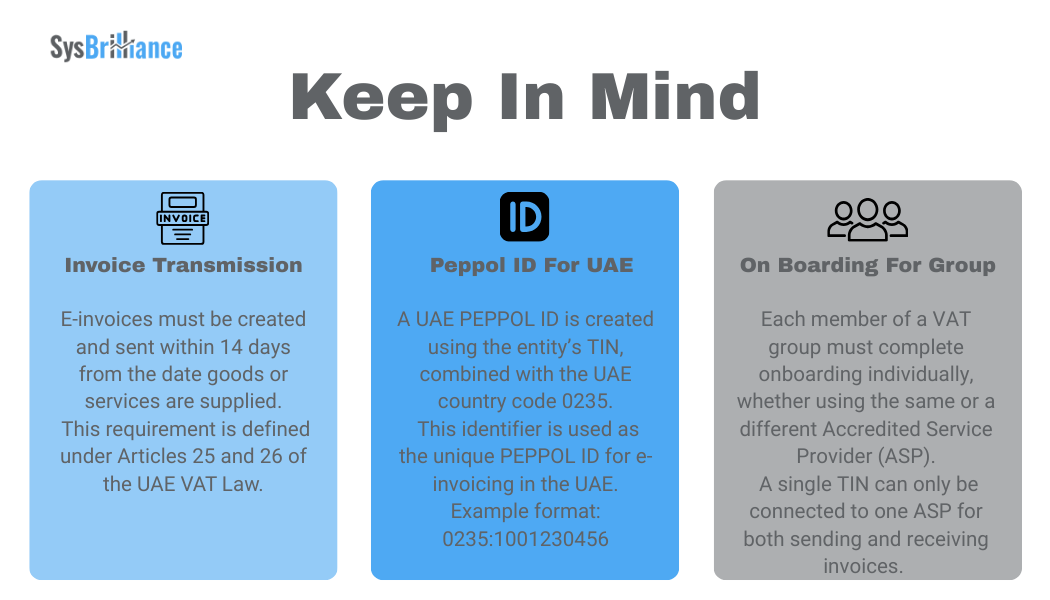
- Invoices must be issued and transmitted within 14 days of the supply of goods or services
- This requirement continues under e-invoicing and reflects the current VAT law
- Once e-invoicing in the UAE applies, invoices cannot be sent by email or manual methods
All invoice exchange and tax reporting must occur through the PEPPOL network, which acts as the official communication channel between businesses and the FTA.
Understanding PEPPOL and PEPPOL IDs in the UAE
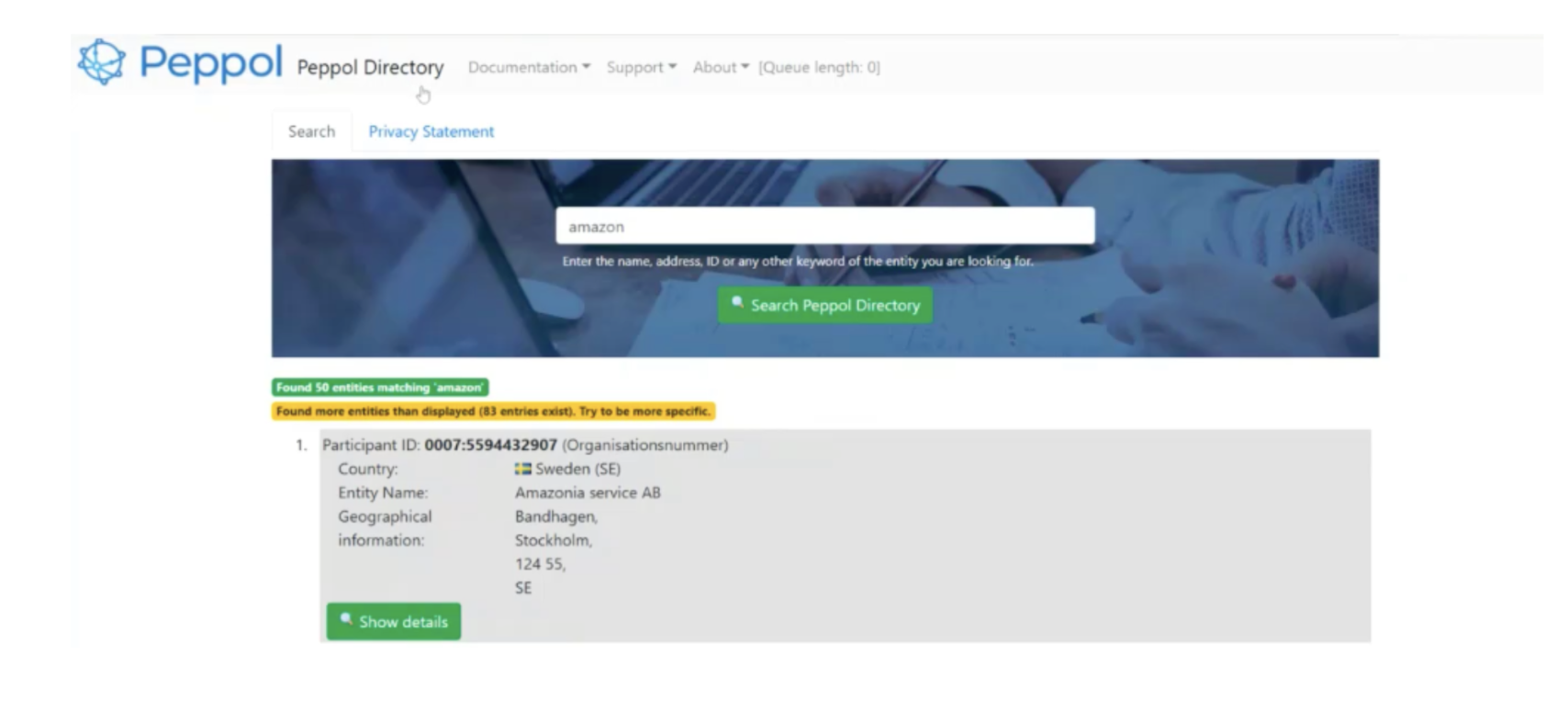
PEPPOL acts as the secure communication network supporting e-invoicing in the UAE. It enables standardised invoice exchange between trading partners while ensuring tax data is reported correctly to the FTA.
Every company required to use e-invoicing must:
- Be listed in the PEPPOL directory
- Receive a unique PEPPOL ID, which functions as a digital address for invoice exchange
UAE PEPPOL ID Format
For UAE entities, the PEPPOL ID follows a standard structure:
0235:XXXXXXXXXX
- 0235 represents the UAE country code
- XXXXXXXXXX represents the first 10 digits of the company’s TIN
Once onboarded, invoices can only be exchanged with trading partners who are also registered on the PEPPOL network using compliant e-invoicing software.
Note: PEPPOL onboarding is handled by your Accredited Service Provider as part of the overall e-invoicing solution implementation process.
Group Companies and ASP Onboarding
For corporate groups with multiple legal entities, onboarding must be handled at an individual entity level.
Key rules include:
- Each legal entity must be onboarded separately
- Each entity receives its own PEPPOL ID
- A single TIN can only be linked to one ASP for sending and receiving e-invoices
Groups may choose to:
- Use the same e-invoicing solution across all entities, or
- Select different e-invoicing software providers for individual entities
The choice depends on operational structure, system architecture, and compliance strategy.
The UAE 5-Corner E-Invoicing Model
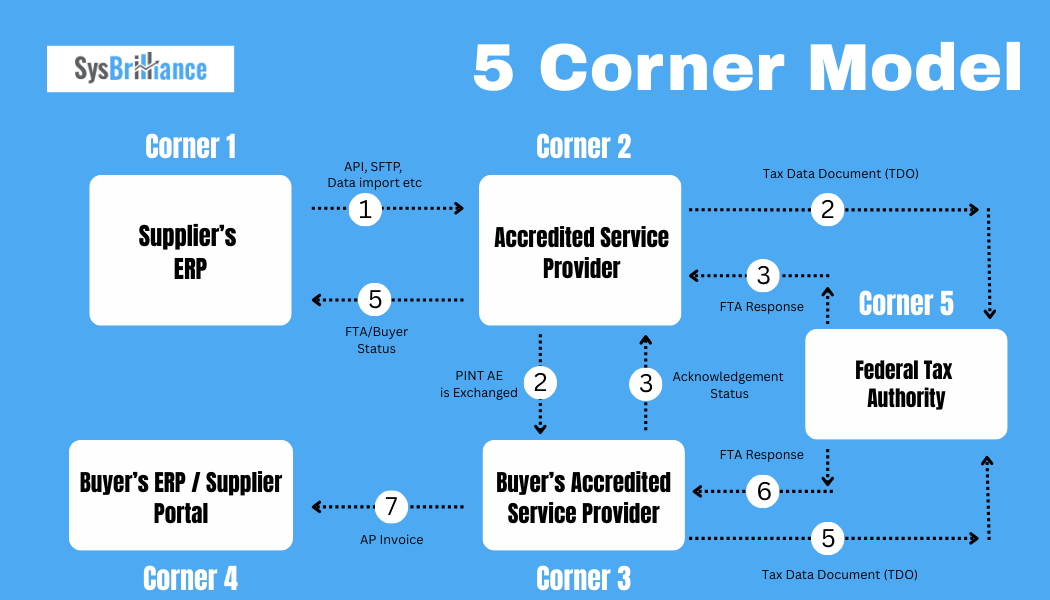
The UAE follows a 5-Corner Model for e-invoicing, involving five parties in every compliant invoice exchange:
- Supplier
- Supplier’s Accredited Service Provider
- Buyer’s Accredited Service Provider
- Buyer
- Federal Tax Authority (FTA)
This model ensures invoices are validated, exchanged, and reported securely using approved e-invoicing software, with clear acknowledgement and audit trails at each step.
Scenario 1: You Are the Supplier
Invoice Creation and Submission
When acting as a supplier, the invoice is created in the company’s ERP system. This may be a modern cloud ERP or a custom in-house solution.
The invoice is then submitted to the supplier’s ASP using:
- API integration
- SFTP
- Another supported integration method
The method used depends on the ERP and e-invoicing solution in place.
Validation and Conversion
Once received, the ASP performs extensive validation checks to ensure:
- Mandatory fields are present
- Data formats meet FTA requirements
- The invoice is eligible for e-invoicing
After validation, the invoice is converted into a PEPPOL-compliant XML e-invoice.
Although not human-readable, this XML version contains the same information as a PDF invoice, structured in a machine-readable format required for e-invoicing in the UAE.
Delivery, Reporting, and Status Updates
Following conversion:
- The e-invoice is delivered to the buyer’s ASP via PEPPOL
- A Tax Data Document is reported to the FTA
- Acknowledgement and reporting statuses are returned to the supplier’s ERP
This allows suppliers to track invoice delivery and compliance status directly within their systems.
Scenario 2: You Are the Buyer
When acting as a buyer, the process mirrors the supplier flow in reverse.
In this scenario:
- The supplier sends the e-invoice via their ASP
- The buyer’s ASP receives it through PEPPOL
- Tax data is reported to the FTA
- AP invoice details and reporting statuses are sent back to the buyer’s ERP
This ensures buyers have full visibility into incoming e-invoices, including receipt confirmation and FTA reporting status.
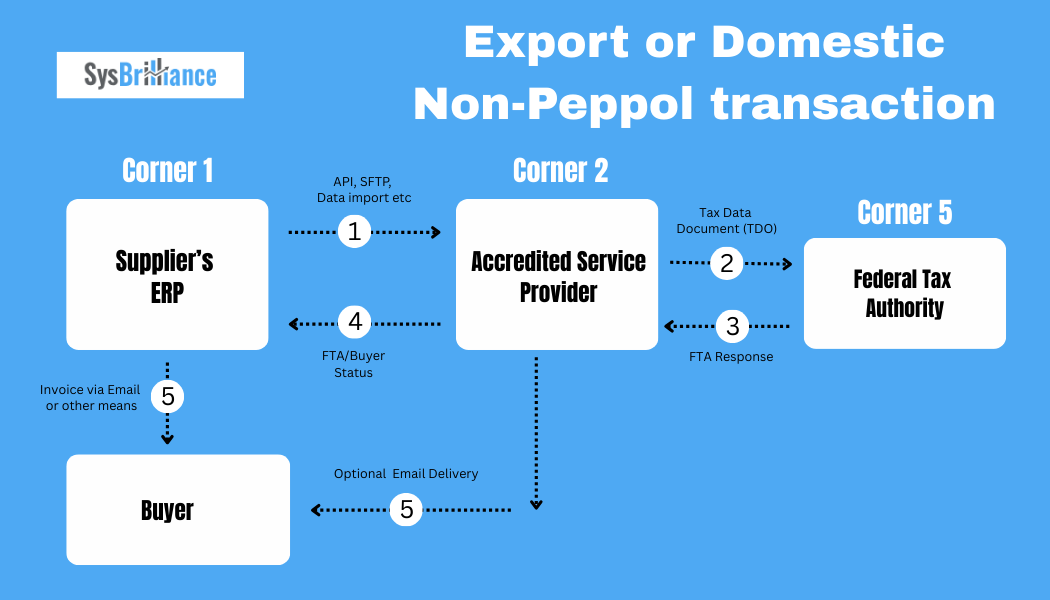
Export and Domestic Non-PEPPOL Transactions
Imports
Imports are exempt from e-invoicing requirements
Exports
- E-invoicing applies
- Buyers outside the UAE are not required to report to the FTA
Domestic Non-PEPPOL (Transition Phase)
During the phased rollout of e-invoicing in the UAE, a supplier may be live while the buyer is not yet mandated.
In this situation:
- The supplier reports tax data to the FTA
- The supplier may send a traditional PDF invoice to the buyer
- The buyer is exempt from reporting until their phase begins
This scenario applies only during the transition period.
Key Takeaways for UAE Businesses
- E-invoicing becomes mandatory for Phase One companies from 1 January 2027
- ASP appointment is required by 31 July 2026
- PEPPOL is the only approved exchange channel
- Each legal entity requires its own PEPPOL ID
- Choosing the right e-invoicing software and e-invoicing solution is critical for compliance
- Transitional exceptions apply only during phased rollout
Conclusion
The UAE’s move toward e-invoicing represents a significant shift in how invoices are issued, exchanged, and reported for VAT compliance. While the framework introduces new technical and operational requirements, the underlying goal is consistency, transparency, and improved tax reporting across the market.
By understanding the phased rollout, PEPPOL onboarding requirements, and the 5-Corner Model, businesses can approach implementation with greater clarity and confidence. Early preparation, the right e-invoicing solution, and alignment between ERP systems and accredited service providers will be key to ensuring a smooth transition.
As mandatory deadlines approach, organisations that take the time to understand how e-invoicing in the UAE works will be better positioned to meet compliance requirements without disruption to their invoicing and finance operations.
For businesses looking for practical guidance and implementation support, SysBrilliance helps organisations navigate e-invoicing requirements and integrate compliant solutions into their existing ERP environments with confidence.
