
The maintenance schedule is where organizations start to move beyond reactive maintenance and into true execution planning. Work orders get created, technicians get dispatched, and maintenance starts to feel more controlled.
But in D365 Asset Management, the real planning power sits one step earlier, in the schedule.
The maintenance schedule is not just an intermediate step before work orders. It is the layer that allows teams to see what is coming, plan capacity, forecast cost, and adapt when reality changes, all without committing too early.
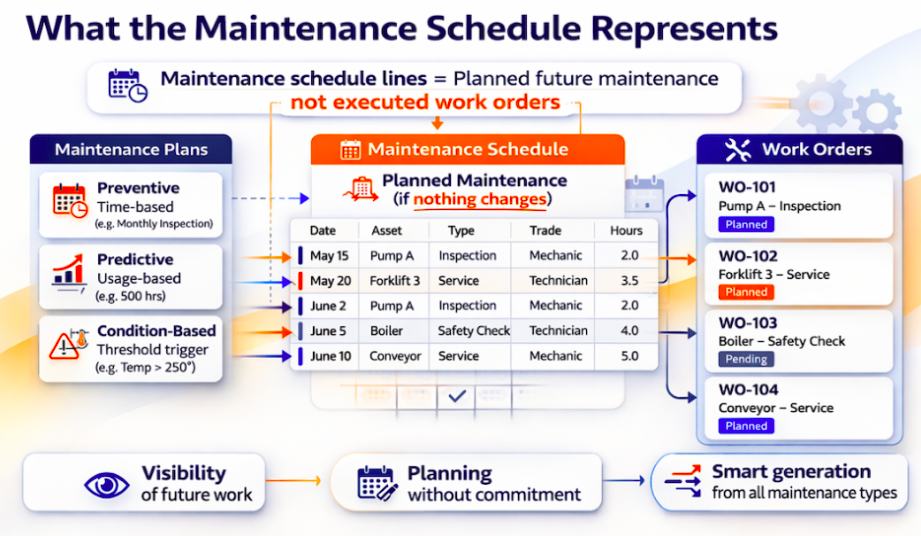
What the Maintenance Schedule Represents
The lines represent planned future maintenance, not executed work.
They are generated from:
- Preventive maintenance plans
- Predictive maintenance forecasts
- Condition-based triggers
Each schedule line answers a simple question: If nothing changes, this is when maintenance would be due.
Because schedule lines exist before work orders, they create visibility without forcing action.
This separation is intentional. It allows maintenance teams to plan ahead while keeping execution flexible within a broader asset management strategy.
Seeing Workload Before It Becomes Work Orders
One of the most practical benefits of the maintenance schedule is workload visibility.
By reviewing schedule lines, teams can:
- See upcoming maintenance weeks or months in advance
- Identify peaks in workload
- Understand which trades or roles will be required
- Spot conflicts before they become urgent problems
Instead of reacting to work orders as they appear, planners can proactively smooth demand.
This is especially valuable in environments where maintenance windows are limited or resources are shared across assets.
Forecasting Capacity and Cost Without Overcommitting
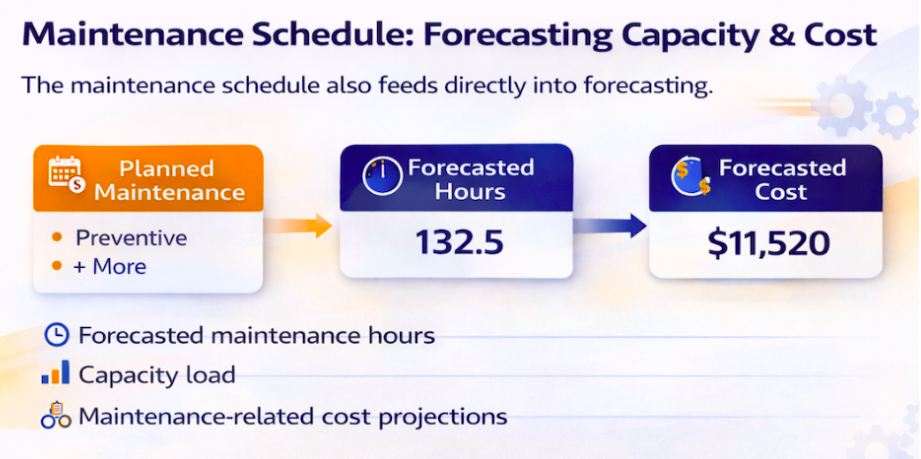
The maintenance schedule also feeds directly into forecasting.
Because schedule lines include estimated labor and resources, D365 can calculate:
- Forecasted maintenance hours
- Capacity load
- Maintenance-related cost projections
All of this happens without creating work orders.
This distinction matters. Creating work orders too far in advance can lock teams into plans that no longer reflect reality. Schedule lines allow forecasting while keeping execution decisions open.
Adjusting Schedules When Reality Changes
Maintenance plans rarely unfold exactly as expected.
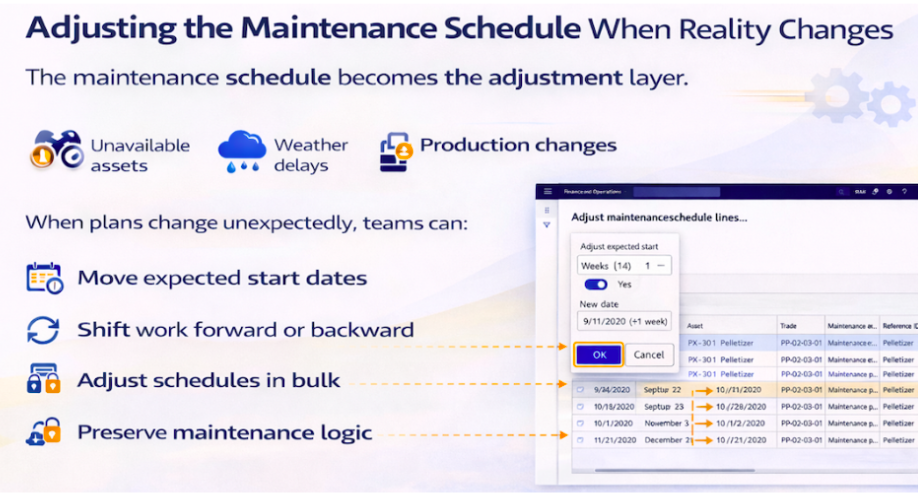
Assets may be unavailable. Weather can delay inspections. Production priorities shift. When this happens, the maintenance schedule becomes the adjustment layer.
Instead of deleting work orders or rewriting plans, teams can:
- Move expected start dates
- Shift work forward or backward
- Adjust schedules in bulk
- Preserve the underlying maintenance logic
This keeps plans intact while allowing real-world flexibility.
Why Schedule Lines Should Come Before Work Orders
A common mistake in maintenance planning is creating work orders too early.
Work orders are execution artifacts. They signal commitment. Once created, they require tracking, updates, and closure. Creating them prematurely removes flexibility and increases administrative overhead.
Schedule lines, on the other hand, support planning without obligation.
Using the maintenance schedule intentionally allows organizations to:
- Plan work without locking it in
- Keep execution aligned with current conditions
- Reduce rework and manual cleanup
In D365, the maintenance schedule is where planning belongs. Work orders should follow when teams are ready to execute.
Turning Maintenance into a Planning Advantage
The maintenance schedule is one of the most underused planning tools in D365 Asset Management. SysBrilliance helps organizations use schedule lines for capacity planning, cost forecasting, and workload visibility, enabling better decisions before work orders are created.

The Maintenance Schedule as the Control Layer
Across preventive, predictive, and condition-based maintenance, the schedule acts as the control layer.
It brings together:
- Time-based planning
- Usage-based forecasting
- Condition-driven triggers
All into a single, adjustable view of future work.
When teams treat the maintenance schedule as more than an administrative step, maintenance becomes proactive, adaptable, and far easier to manage.
Take control of your maintenance operations with a smarter, fully integrated scheduling approach in Dynamics 365. If you’re ready to reduce downtime, improve visibility, and make your maintenance strategy truly proactive, contact SysBrilliance today to get started.
