
Most maintenance teams do not struggle because they lack tools. They struggle because their maintenance strategy has not evolved alongside their operation.
As operations grow, asset management becomes more complex. There are more assets, more risk when something fails, and less room for guesswork. Even with D365 asset management in place, many teams still operate in reactive or calendar-driven mode.
This is not a system limitation. It is usually a maturity gap.
Understanding how maintenance maturity evolves, and how asset management capabilities in D365 support each stage, is essential before configuring plans, counters, or automation.
How Maintenance Maturity Typically Evolves
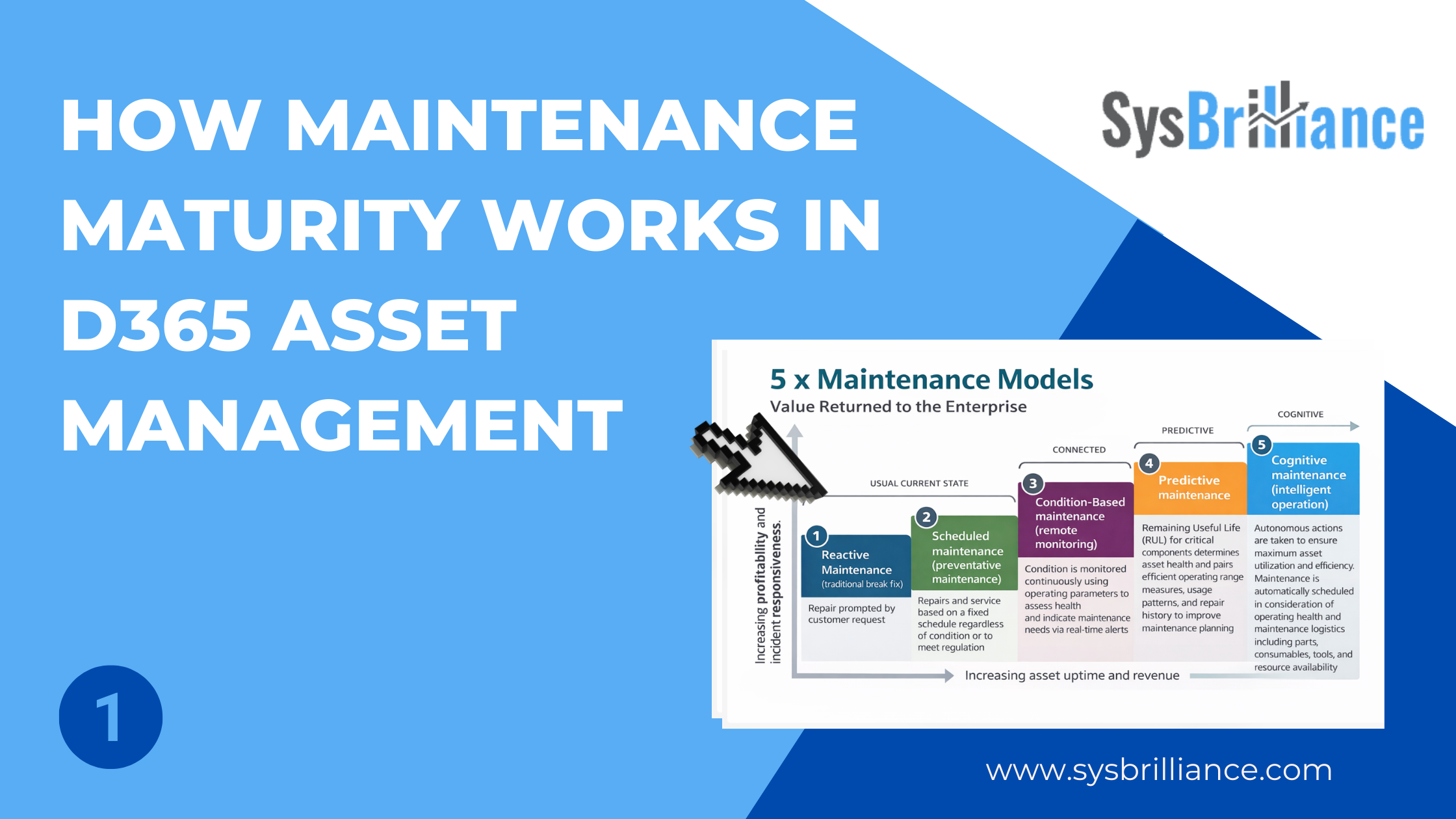
While terminology varies, most organizations move through the same core maintenance stages over time. Each stage builds on the previous one, and skipping steps often leads to frustration or underused functionality within an asset management system.
Reactive Maintenance: Fixing What Breaks
Reactive maintenance is where most teams start.
Work orders are created only after an asset fails. Something stops working, someone reports it, and maintenance responds. This approach is simple, but it is also unpredictable and costly at scale.
D365 Asset Management supports reactive maintenance through basic work order creation and tracking. The system records what happened, but it does not prevent repeat failures.
Reactive maintenance is not inherently wrong, especially early on. The problem arises when organizations remain here longer than necessary and rely on reactive processes as their primary asset management approach.

Preventive Maintenance: Introducing Structure Through Time
The next step is preventive maintenance.
Instead of waiting for failures, teams schedule work based on time. Weekly inspections. Monthly servicing. Annual overhauls. Maintenance happens whether the asset needs it or not.
D365 supports this through maintenance plans and maintenance rounds, allowing organizations to define recurring work on individual assets or groups of assets. Understanding the difference between these approaches and how scheduling works behind the scenes is critical and is covered in more detail in our breakdown of preventive maintenance in D365 Asset Management .
Preventive maintenance improves reliability, but it also introduces inefficiency. Assets may be serviced too early, too late, or unnecessarily. As asset complexity grows, time-based schedules alone start to show their limits.

Condition-Based Maintenance: Responding to Asset Behavior
Condition-based maintenance moves away from the calendar and toward reality.
Instead of asking when maintenance should happen, teams ask whether maintenance is actually needed. This is based on live or regularly updated measurements such as temperature, pressure, or vibration.
D365 Asset Management supports condition-based maintenance through counter-based maintenance plans that can trigger work orders when defined thresholds are exceeded. For example, a work order can be generated automatically if a temperature reading crosses a safety limit.
It is important to note that condition-based maintenance in D365 reacts to individual counter values, not accumulated totals. That distinction affects how and when work orders are triggered and is explored in more depth in our guide to condition-based maintenance in D365 .
Predictive Maintenance: Planning Ahead Using Trends
Predictive maintenance answers a different question.
Not whether something is wrong today, but when it is likely to go wrong in the future.
Rather than reacting to thresholds, predictive maintenance looks at patterns in asset data. Rate of change. Average usage over time. Based on these trends, the system can estimate when a future service point will be reached and schedule maintenance accordingly.
D365 Asset Management supports predictive behavior by analyzing counter history and projecting future values. This allows teams to plan maintenance before failures occur, improving uptime and resource planning.
However, predictive maintenance in D365 has important constraints. Forecasting is based on counter behavior, not aggregated lifetime totals like total mileage. These limitations often surprise teams and can lead to incorrect assumptions if not understood upfront. We unpack what works and what does not in our detailed look at predictive maintenance in D365 Asset Management.

Maintenance as a Planning Function, Not Just Execution
At higher maturity levels, maintenance stops being purely reactive or task-driven.
It becomes a planning discipline.
Instead of focusing only on individual work orders, teams look ahead at workload, capacity demand, and expected cost. Maintenance schedules are used to understand what is coming, even if work orders are not created yet.
D365 supports this through maintenance schedules that allow organizations to forecast maintenance activity over long horizons and include that information in capacity planning. This capability is often underused, despite being one of the most valuable tools for maintenance leaders. We explore this planning perspective further in our article on using the maintenance schedule for capacity and forecasting.
Why Maintenance Plans Sit at the Center of Everything
Across all maturity stages, one concept remains constant: the maintenance plan.
Maintenance plans define what work should occur, under what conditions, and on which assets. They are the foundation for preventive, condition-based, and predictive maintenance in D365 Asset Management.
Automation without well-designed maintenance plans does not create value. It only accelerates poor decisions.
Understanding how plans, schedules, counters, and supporting asset management tools interact matters far more than knowing where to click in the system.
How SysBrilliance Supports Maintenance Strategy in D365
SysBrilliance works with organizations to align maintenance design with real system capabilities, helping teams choose the right mix of preventive, condition-based, and predictive maintenance based on how D365 actually behaves.

A Realistic View of Maintenance Maturity
Not every organization needs fully predictive maintenance to succeed.
For many teams, a combination of preventive and condition-based maintenance delivers most of the value. The real risk lies in assuming maturity without understanding system capability.
D365 Asset Management provides powerful tools, but each operates within specific rules.
Organizations that understand those rules are better positioned to design maintenance strategies that are realistic and aligned with operational goals.
Talk to SysBrilliance about your maintenance maturity
If you are unsure which maintenance stage your organization is actually operating in, we help teams map current behavior against real D365 capabilities and design a strategy that fits how the system really works.