
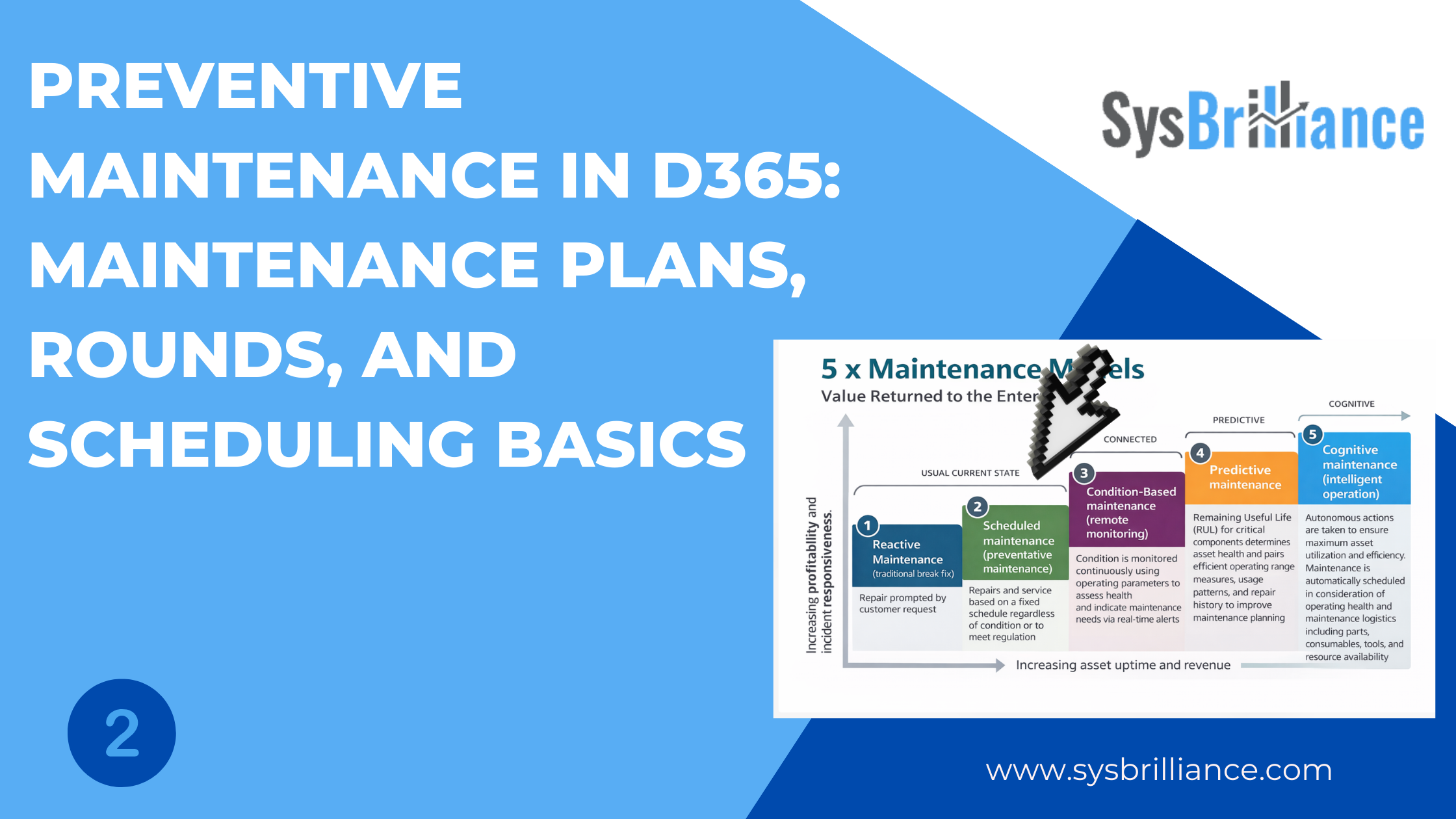
Preventive maintenance is usually the first real shift away from reactive work. Instead of responding only when something fails, teams begin scheduling maintenance in advance to reduce downtime and create more predictable operations.
In D365 Asset Management, preventive maintenance is built around time-based planning. Work is scheduled at fixed intervals such as weekly, monthly, or annually, regardless of asset condition. When set up well, this approach brings structure and visibility. When misunderstood, it can quietly create unnecessary work.
Understanding how preventive maintenance is structured in D365 helps teams make better decisions long before any work order is created.
How Preventive Maintenance Works in Practice
At a high level, preventive maintenance in D365 follows a simple flow:
- Maintenance plans or rounds define what work should occur
- The scheduling process calculates when that work is due
- Maintenance schedule lines are generated
- Schedule lines can later be converted into work orders
One important detail often overlooked is that scheduling and execution are separate. The system allows teams to plan future maintenance without immediately committing to work orders, which is key for capacity and cost planning in any asset management environment.
Maintenance Plans and Maintenance Rounds
D365 supports preventive maintenance through two main structures: maintenance plans and maintenance rounds.
Maintenance plans are most commonly used when maintenance is tied to specific assets or functional locations. They allow flexibility in scheduling and support multiple time-based intervals within a single plan.
Maintenance rounds are better suited to standardized tasks that are performed together across many assets, such as routine inspections or safety checks completed as part of a fixed route.
For most organizations, maintenance plans form the backbone of a scalable preventive maintenance program.
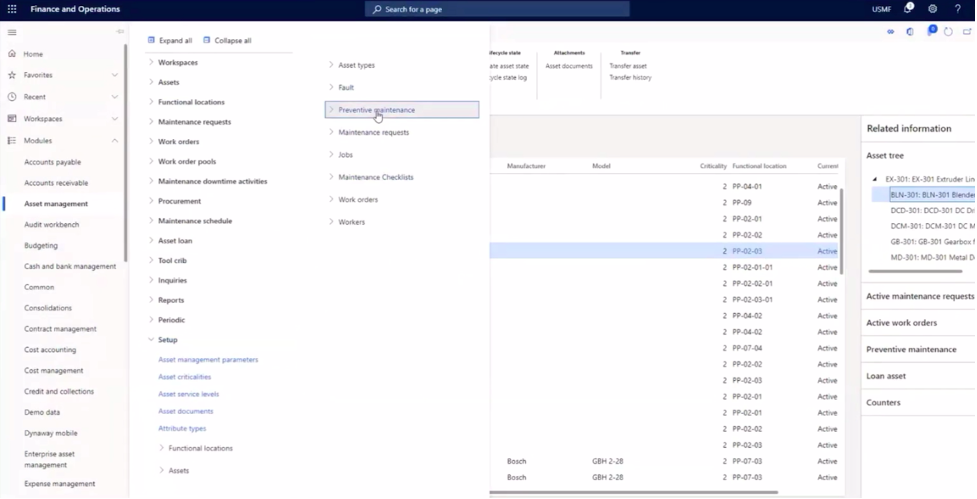
Structuring Preventive Maintenance with Maintenance Plans
A maintenance plan defines recurring work based on time. One of the most useful features is the ability to include multiple time-based lines in a single plan.
For example, the same asset might require:
- A weekly inspection
- A monthly service
- An annual safety check
All three can be defined within one maintenance plan, each with its own interval and job type.
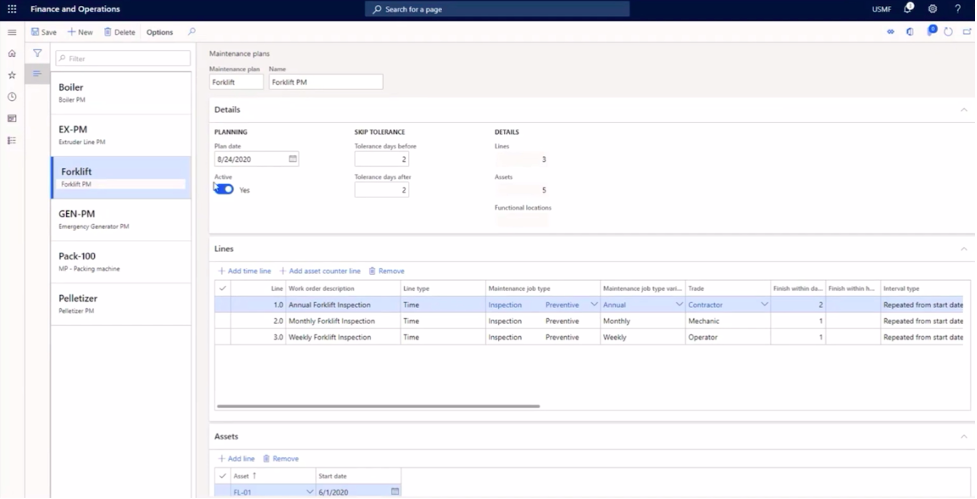
This layered approach keeps related maintenance aligned while avoiding the need to manage separate plans for each interval.
How Time-Based Scheduling Behaves
Each time-based line in a maintenance plan is evaluated independently. Weekly, monthly, and annual lines are calculated separately based on their start dates and interval definitions.
This means overlapping maintenance is expected.
To manage this, D365 includes tolerance and suppression logic that helps control how overlapping schedules are handled. For example, an annual inspection can suppress a monthly inspection if both are due around the same time, preventing unnecessary duplication.
This logic allows teams to balance coverage with efficiency rather than relying on manual cleanup.
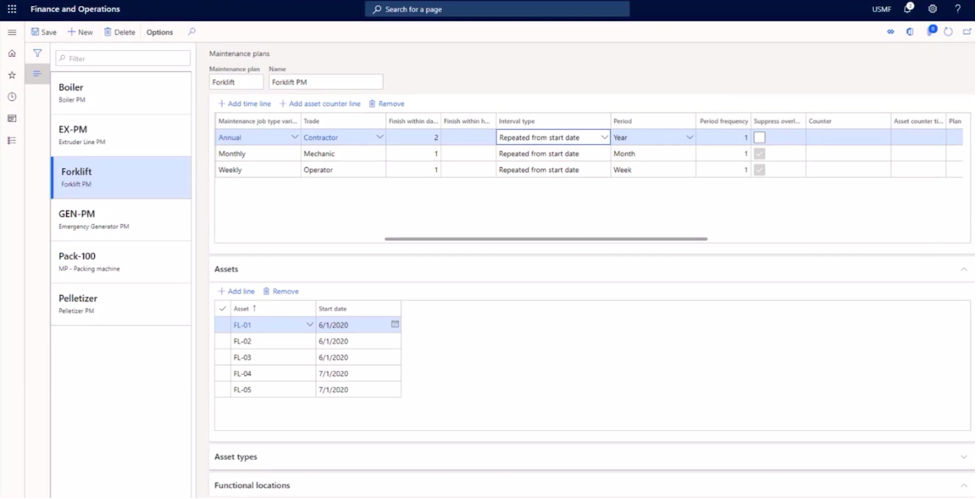
Turning Plans into Scheduled Maintenance
Once maintenance plans are defined, scheduling generates maintenance schedule lines.
Schedule lines represent planned maintenance events tied to specific dates and assets. They are not work orders. At this stage, nothing has been executed.
This separation allows teams to:
- View upcoming maintenance workload
- Plan labor and capacity
- Forecast maintenance-related costs
- Adjust timing before execution
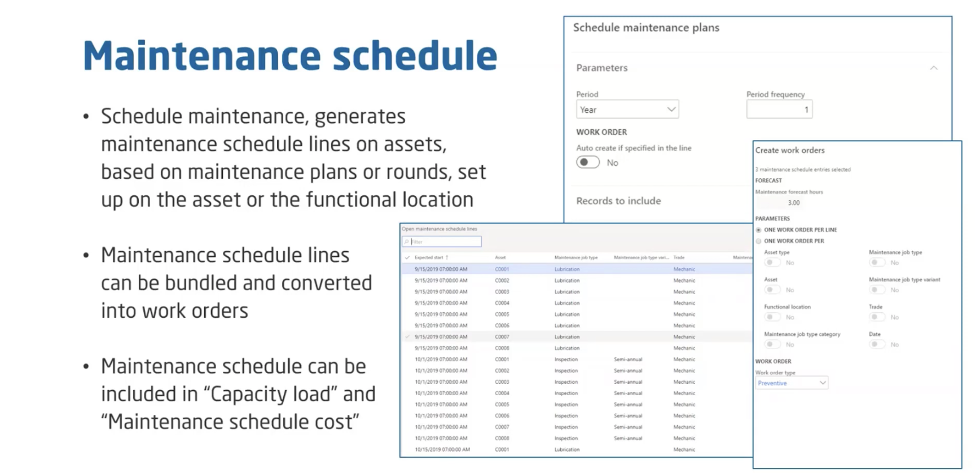
Schedule lines act as a planning layer, giving visibility without forcing commitment.
Converting Schedule Lines into Work Orders
When maintenance is ready to be executed, schedule lines can be converted into work orders.
D365 allows flexibility in how this conversion happens. Schedule lines can be:
- Converted one-to-one into work orders
- Bundled together into a single work order
- Grouped by asset or functional location
This flexibility helps align system behavior with how maintenance work is actually performed in the field.
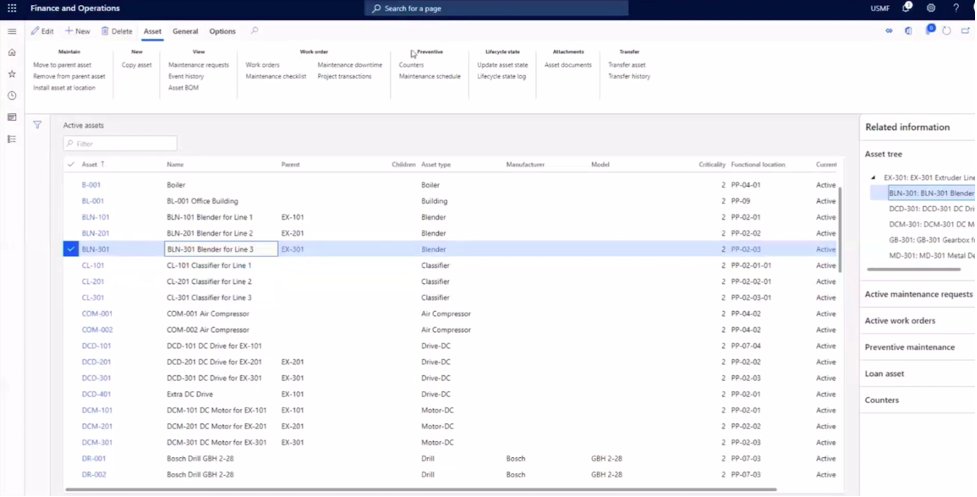
Where Preventive Maintenance Starts to Show Its Limits
Preventive maintenance brings predictability, but it is still based on time rather than asset behavior.
Assets may be serviced too early, too late, or unnecessarily. As operations grow and asset usage becomes less uniform, fixed schedules alone often stop delivering optimal results.
At this point, many teams begin looking at approaches that factor in asset behavior rather than dates. D365 supports this shift by using asset trends to forecast when maintenance is likely to be needed, rather than relying solely on fixed intervals. How that predictive logic works, and where its limitations are, becomes clearer when looking at predictive maintenance in D365 Asset Managemen.
In other cases, maintenance is triggered by specific conditions being reached, such as temperature or pressure thresholds, which introduces a different maintenance model entirely. That approach is explored further in our discussion of condition-based maintenance.
What comes after time-based maintenance?
Learn how condition-based and predictive maintenance work in D365, and where their limits matter in real operations.
Designing Preventive Maintenance That Actually Scales
Preventive maintenance works best when plans are structured intentionally, and scheduling is used as a planning tool, not just a work order generator. SysBrilliance helps organizations design preventive maintenance models in D365 that balance coverage, efficiency, and real operational constraints, before automation is applied.
Talk to Sysbrilliance . We help teams design maintenance plans, rounds, and scheduling logic that scale without creating unnecessary work or hidden inefficiencies.
Preventive Maintenance as a Foundation
Preventive maintenance is not the final stage of maturity, but it is a critical foundation.
When maintenance plans are structured thoughtfully, and scheduling is used intentionally, teams gain control and visibility. When plans are poorly designed, automation simply accelerates inefficiencies.
A strong preventive maintenance program sets the stage for more advanced approaches by establishing consistent planning, clean data, and predictable workflows. From there, organizations can decide how far along the maturity curve they want to go.